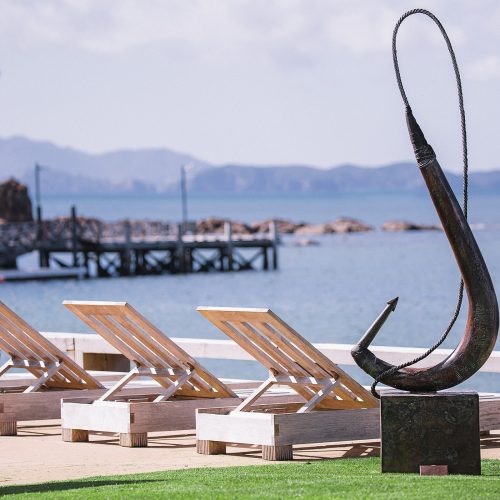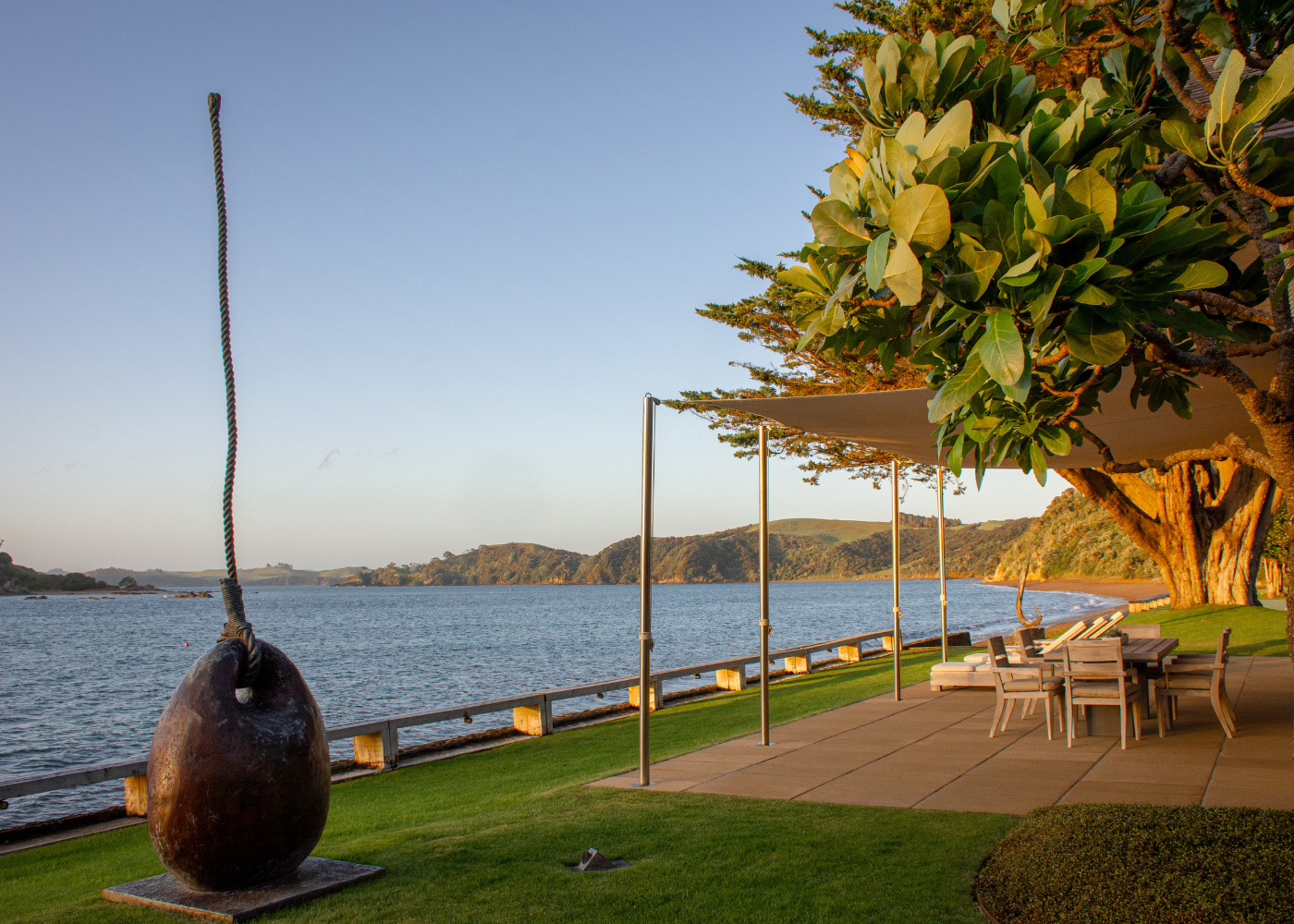
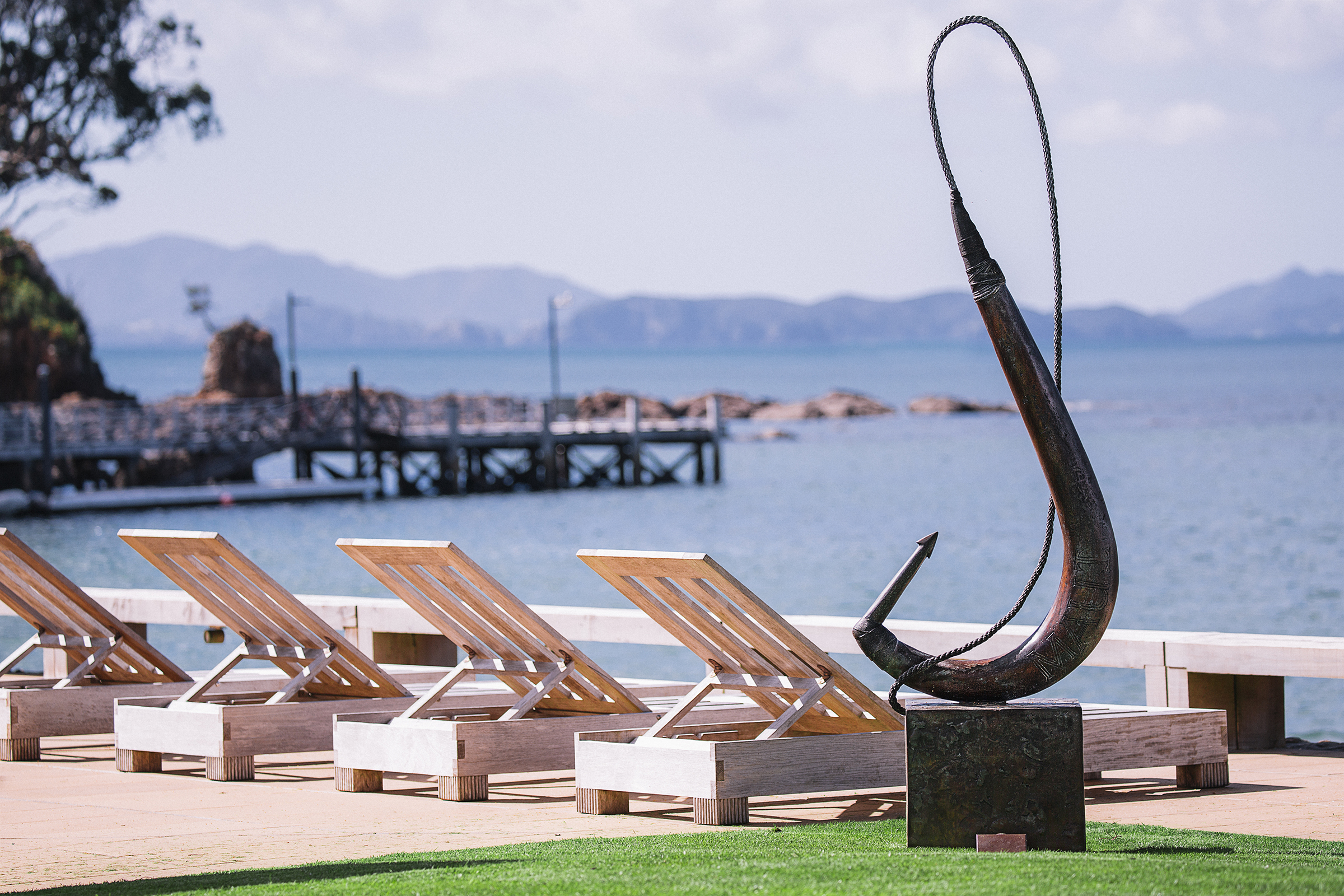
If you’re staying at The Boathouse, take a few minutes to appreciate the works Fishhook (pictured left, 2003) and Anchor Stone (pictured right, 2002) by renowned New Zealand sculptor Paul Dibble.
These works were acquired for The Landing in 2004 by owner Peter Cooper and are part of his personal collection. At the time of acquisition, Paul was very well-established as an artist but had only recently set up his own bronze foundry, which allowed him to cast larger works such as these.
These works represent two traditional Māori fishing tools; the hei matua, or fishing hook, and the punga, or anchor stone. Mahe, or traditional fishing sinkers, often look similar to anchor stones, but are much smaller. Examples of these, and of Maori fishhooks, can be found at the Cooper Residence in the artefacts collection.
Traditional hei matau were made of wood and bone, while mahe and punga were stones with holes drilled through them. Paul’s works are cast bronze, which after 20 years in the salty air of Wairoa Bay, have weathered to a beautiful patina.
The idea of the fishhook, and in particular the fishhook that the hero Māori used to fish up the North Island in Māori legend, is referenced many times in Paul’s works, alongside birds, rabbits, elongated figures and kowhai flowers. The anchor stone is by contrast a much less common subject for him, making this piece quite unique.
If these works spark a further interest in Paul Dibble, you can find public sculptures by him in nearly every major city in New Zealand, as well as overseas – Southern Stand: The New Zealand Memorial, a work of 16 cast bronze crosses, was commissioned for Hyde Park Corner Corner in London to remember New Zealanders lost in British wars.
Paul passed away in 2023, but a full archive of his work can be found here: pauldibble.com