
Each Residence is designed to frame aspects of New Zealand’s unique and beautiful landscape, to encourage contemplation and appreciation.
Architecture
In the four residences designed by Cheshire Architects, several key features have been prioritised by the designers.
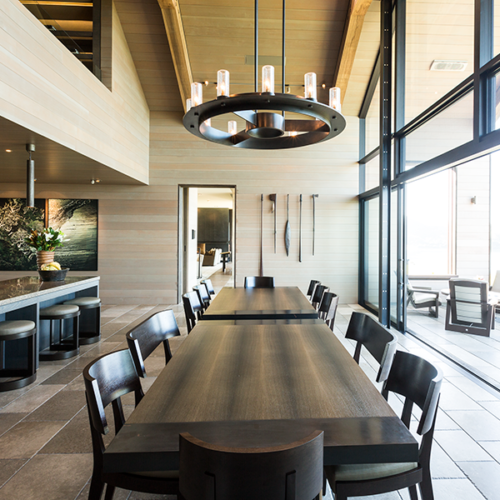
The Cooper Residence was designed by acclaimed New Zealand architect Pip Cheshire and the interior created by renowned Seattle designer Terry Hunziker. It was finished in 2012 and has remained a beloved vacation home for Peter Cooper and his family. It can sleep up to 12 and has a floor area of 1142m2, including the Barrel Room.
The house is modelled on a basic cruciform shape. A long barn-like structure flanked by two contemporary pavilions accommodates the master bedroom and main living areas. The interior is luxurious with an industrial edge, featuring rough-hewn wood, blackened steel, and exposed bolts.
Walls and ceilings are lined with rich timber, the monumental scale of the house carried through in the heavy beams and huge rusticated steel fireplace. Finishes are contemporary and eclectic, incorporating exotic textures such as animal skins, stone, metals, and woven Māori panels. At the northwestern end of the house is an elliptical stone ‘remnant tower,’ which houses a wine cellar and tasting room. Above, an atmospheric king bedroom suite offers a unique private retreat and above that, a sunny curved ‘observatory’ roof deck provides an intimate dining or function space.
The house was designed with the concept of three time periods: 200-year-old stone ruin, mid-century barn form that runs through the centre, and the two contemporary wings (living/dining/library). Both the exterior and interior are cedar wood. The form of the house echoes the historical icon of Marsden’s Cross with the main room of the Residence in the shape of a cross. Stone was quarried from a nearby farm site and was used to build the ‘remnant tower.’ The wine cellar has a beautiful handmade chandelier built of motorcycle chain and industrial gear wheel with cast glass hangers and has 200 hand blown pieces.
Landscape architect Christine Hawthorn shaped the grounds around the Cooper Residence to contain several large mature pohutukawa trees that have been used to tie the building into the landscape. Large sweeping lawns and minimal planting have been adopted in some areas so not to detract from the stunning sea views, majestic pohutukawa and unique architecture. Additional semi-mature pohutukawa trees were transplanted to provide a framework for the garden to be designed around.
Cooper Residence
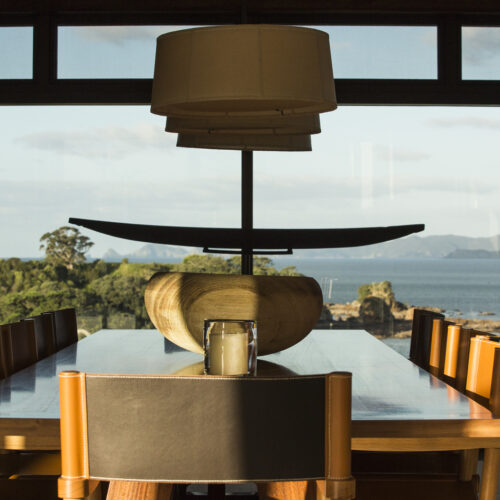
Designed by Cheshire Architects and built in 2009, the Gabriel Residence was envisioned to be a building that, from the outside, would start to relax into the land over time and take on some of the colouring of the surrounding trees and landscape. Located on a beautiful piece of coastline, the lodge can sleep up to 8 and has a floor area of 1000m2.
The Gabriel Residence is a modern home that nestles into the slope of the land. The house is constructed in unfinished hardwood timber and raw concrete, allowing it to soften into the coastal landscape and giving it the feel of a traditional hunting and fishing lodge. Inside, with the help of US interior designer James Radin, they were keen to develop a powerful sense of enclosure that would bring together the extended family holidaying there while allowing the spaces to become part of the unique mix of farm and seascape.
Furnished with an understated mix of modern pieces, New Zealand antiques and Pacific art, the interior is full of the natural tones and textures of wood, rich textiles, stone and metal. Pacific identity was central to Pip Cheshire’s creative focus, and he describes the house design as hovering “somewhere just south of Hawaii”. For the ceiling, they have used Tasmanian oak, for the flooring white oak sourced from New Hampshire, USA and for the decking and internal walls, spotted gum. The high, open, airy rooms were created to make the most of the views out and the luxurious bedrooms.
Gabriel Residence
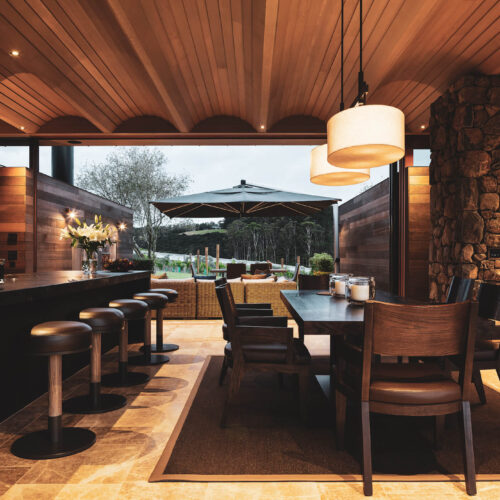
The Vineyard Villa was completed in 2015. It was designed by Nat Cheshire and the interior was created by David and Suzie Lucas. It is a house made up of two simple forms straddling a stone landscape wall. Its tectonic and material strategy is drawn from the land and pursues mass and organic warmth. The outlook beyond sweeps down over hills and through a valley to the sea. The roof above is a great slab, cantilevered off the rock wall, securing you to the land. It can sleep up to 6 and has a floor area of 231m2 plus 73m2 of balconies and courtyards.
The house is designed around a massive stone landscape wall?that emerges from the vineyard hill like a relic of a prior occupation of the land. The idea of the relic takes its lead from Pip’s design philosophy with the stone tower at the Hilltop House. Stones pulled from the fields and hills of the surrounding area are used to create the wall, which helps to firmly ground the house in its site and emphasise the importance of the house’s connection to the landscape around it.
The roof is designed to reinforce that sense of mass and permanence, whilst also allowing it to span the long distances necessary for the sliding doors to roll away open the house wide, opening the living space enough that the house transforms into a lushly furnished covered terrace. Cheshire says that when it is fully open, especially in those idyllic Bay of Islands months, “it really is like you are living on the deck of a boat and you’re outside rather than in a house.” This balances the dramatic nature of the stall. The interiors of the home are a collaboration with US-based Lucas Design Associates. Downstairs, the intimate bedroom spaces, stonework and lovely intrusions of soft light give the floor a subterranean feel. The ceiling is vaulted to help create a powerful sense of interior, in a room that is otherwise largely glass. Those vaults recall the ceilings of cellars but are made from timber planks more like wine barrels.
Vineyard Villa
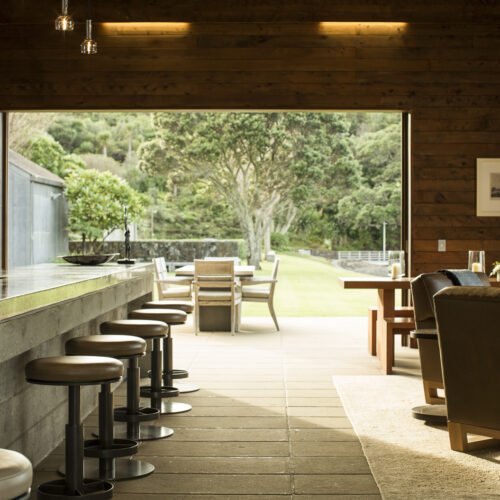
Built in 2003 and designed by prominent New Zealand architect Pip Cheshire, the Boathouse is an elegant modern interpretation of a traditional form in natural wood and stone. This small but highly serviced building was built to the floor plan of the original shearing shed. Perched on the water’s edge, the Residence is a great base for activity-based holidays. It can sleep up to four and has a floor area of 140m2.
The interior aesthetic, envisioned by Terry Hunziker, is ‘mid Pacific’ with large-scale furniture and clearly defined interior space. The stairs and upper floors use Australian black bean, and the internal and external walls are Northland macrocarpa. The timbers and stone selected for internal and external use was chosen to avoid maintenance and to weather softly, becoming part of the seashore.
The canopy was added to the Boathouse to provide shelter from summer sun, rain showers and to allow entertaining to continue through the occasionally tempestuous weather. Highly polished tapering jarrah arches combine with stainless-steel brackets to suggest a little of the romance of timber yacht technology and soften the sharper line of the fabric and perimeter steel beams. The laminated beams allow considerable loads involved in the tensioning of the fabric to be transferred to the perimeter beams, achieving a low-rise volume free from internal supports.
The Boathouse

The house was threaded between two existing Pohutukawa, which provide a psychic anchor to the site and a foil to the rectilinear form when seen from afar.
The Cooper Residence is centripetal, with elements flung from the central entertaining hub to create spaces providing shelter from the winds, privacy, reflection and celebration. A number of design strategies ties the composition into an extensive encampment; these include formal axial connections to places of pre-contact importance and informal routes to secluded delight. Though built in a single burst of construction, the aesthetic programme for the house proposes an assemblage of elements arising from incremental occupation in the site: the stone-clad tower alluding to early commercial activity in the bay, an adjacent barn-like gabled form suggesting farming use and low flat-roofed wings a contemporary addition.
Just over the fence from the Hilltop House (Cooper Residence) lies a structure commemorating the first formal engagement of Maori and Pakeha, the 1814 sermon by Bishop Selwyn, invited here under the aegis of local chief Ruatara. Not surprisingly, the project had a fraught nativity as church and mana whenua struggled for a common understanding for whether such an event should be commemorated and, if so, how. After a few false starts, the project was distilled into a contemplation of the ways in which whenua use market the two cultures coming together: the incised hilltop pa site and kumara furrows on the south flanks of the valley, and the number-eight-wire fence and sheep on the north. The structure we made is an open shelter: parabolic rammed-earth walls surmounted by a triangulated canopy of composite construction. The project built on my earlier life running a fiberglass-molding factory, updated with contemporary manufacturing in which we modelled in Rhino, passed the digital model across for structural analysis before being passed again into Catia software for detailed reinforcement specification and fabrication.
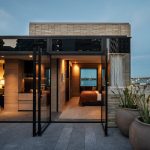
The Landing Residences in the Bay of Islands and The Landing Suites at The Hotel Britomart in Auckland are thoughtfully connected through a cohesive design that emphasises their shared heritage and stunning environments. The five suites at The Hotel Britomart are named after bays at The Landing—Wairoa, Rangihoua, Hohi, Poraenui, and Te Puna—and feature photography that captures the beauty of these areas, giving guests a visual link to the Bay of Islands. Guests can also enjoy exclusive wines from The Landing vineyard, further strengthening the connection between the two locations.
Both properties were designed by Cheshire Architects, with Lucas Interiors contributing to the residences, and they share materials like wood panelling and stone floors. While the suites exhibit urban sophistication, the residences evoke a natural, welcoming warmth. Art is integral to both spaces, with curated collections that include works by Shane Cotton and photographs from The Landing that reflect both Māori and Pākehā cultural perspectives. Elements like pōhutukawa branches and a living tōtara tree, sourced from The Landing, are incorporated into the suites and the lobby, enhancing the bond between the properties. This synergy creates a seamless experience for guests, blending the natural allure of the Bay of Islands with the refined luxury of Auckland.